
Last updated September 10, 2026
Full 25-point door and opener safety check with every visit - springs, cables, rollers, tracks, and your LiftMaster or Chamberlain opener included
You get a price before we start. It does not change when the truck arrives.
 Before
 After
After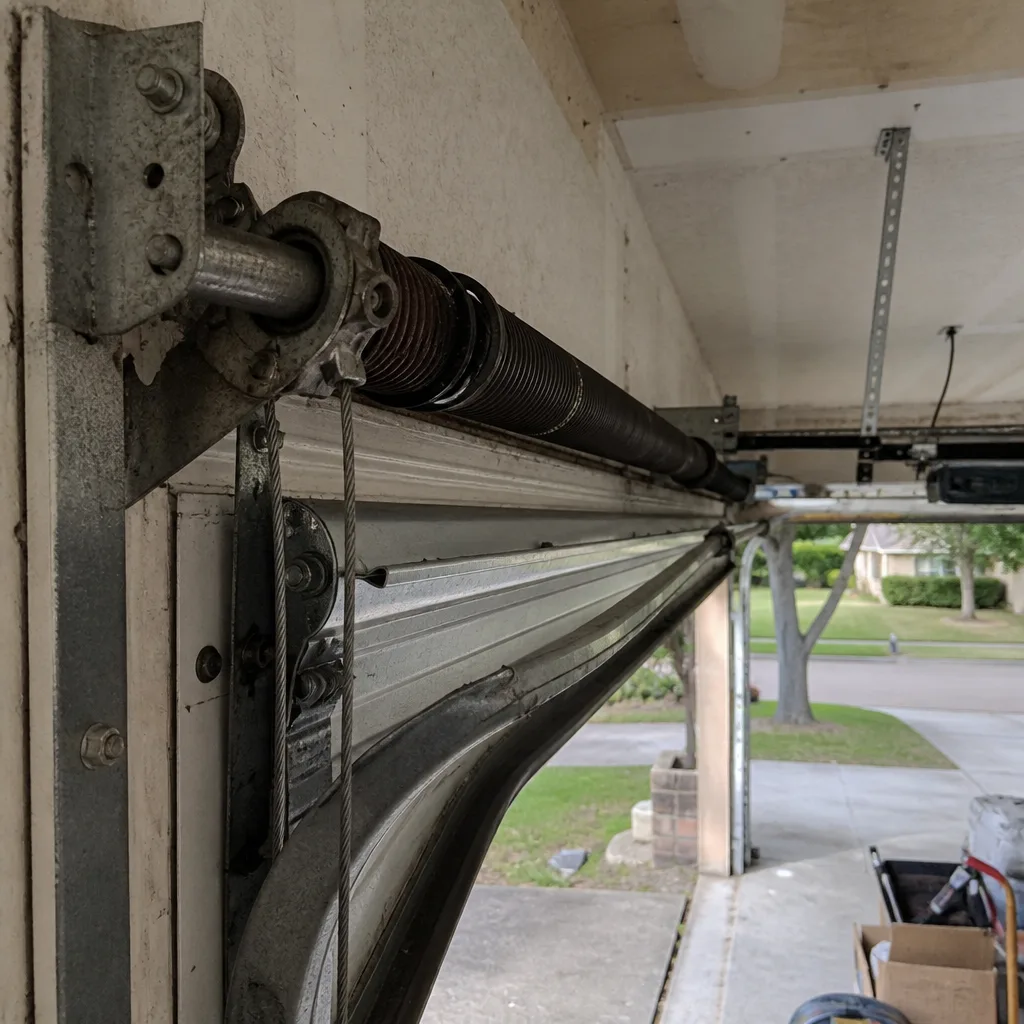 Before
 After
After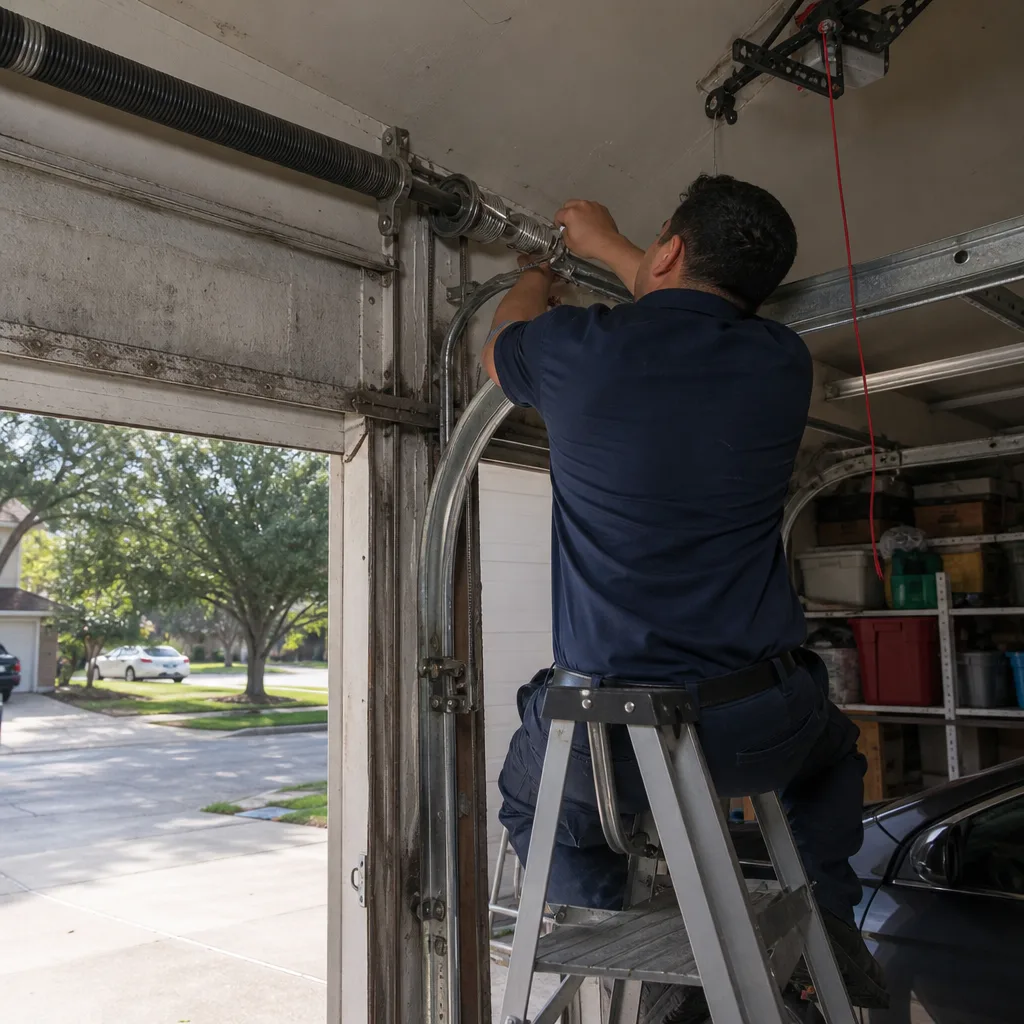 Before
 After
AfterDIY vs Professional Garage Door: The Sugar Land Homeowner’s Decision Guide
Here’s a number most homeowners in Sugar Land never hear: a standard 7-foot residential garage door weighs between 130 and 200 pounds. It rides on two torsion springs, each under enough tension to send a grown man to the emergency room if it lets go while you’re holding the wrong tool. The YouTube videos make spring replacement look like a 20-minute Saturday project, and the comments section is full of people saying “saved myself $300!” What you don’t see are the ones who spent a night in Memorial Hermann with a shattered wrist, or the ones who paid $900 to fix what their $40 attempt broke. This guide isn’t going to tell you to never touch your garage door. Otto has been fixing doors in Sugar Land since 2004, and he’ll be the first to tell you which jobs you can absolutely handle yourself. He’ll also be the first to tell you which ones will hurt you if you make a mistake. By the end, you’ll know exactly where that line is, what it costs on each side, and why Sugar Land’s soil makes some of these decisions different than they would be in, say, Houston proper.
Quick Answer
Most garage door maintenance in Sugar Land is genuinely safe for a homeowner: lubricating hinges and rollers, aligning photo-eye sensors, replacing opener remote batteries, and swapping worn weatherstripping. But torsion spring replacement, cable work, and anything that involves touching the track anchoring system are professional jobs in every case, because those components hold stored mechanical energy that can cause serious injury when released incorrectly. The honest math: you can save roughly $80 to $100 a year doing basic maintenance yourself, but a failed DIY attempt on a spring or cable will typically cost three to five times more to fix than calling a pro the first time.
Table of Contents
- The Definitive List of Safe DIY Tasks in Sugar Land
- The Hard Stop List: When DIY Becomes Dangerous
- The Cost Math Done Honestly
- Sugar Land Soil: The Hidden Variable in Every Door Problem
- How to Describe a Problem So You Get an Honest Scope
- Common Mistakes to Avoid
- When to Call a Professional
- Frequently Asked Questions
The Definitive List of Safe DIY Tasks in Sugar Land
Let’s start with what you can do. And we’re not giving you permission so much as a Garage Door Repair Maintenance Checklist for Sugar Land Homeowners, because these four tasks cover about 80% of the “my door is acting weird” calls we get in Sugar Land. None of them require special tools beyond what’s already in most garages, and none of them involve tensioned parts.
1. Lubricating Hinges, Rollers, and Springs
This is the single highest-ROI maintenance task in your garage. A door that screeches when it opens isn’t necessarily breaking, it’s just dry. Here’s the exact process Otto uses on every tune-up visit:
- Buy the right lubricant. You want a lithium-based spray grease or a dedicated garage door lubricant. Do not use WD-40. It’s a solvent, not a lubricant, and it’ll strip whatever grease is still on there. White lithium grease in a spray can runs about $8 at any hardware store in Sugar Land.
- Spray the hinges. There are usually four to six hinges down each side of the door. One short spray on each pivot point is plenty. Wipe the excess with a rag.
- Spray the rollers. If you have metal rollers, spray where the wheel meets the stem. If you have nylon rollers, the wheel itself doesn’t need lube, but the stem bearing does. About once a year.
- Spray the torsion spring. A light coating along the entire spring, then run the door up and down once to work it in. Wipe any drips off the floor because dried grease stains concrete.
- Spray the opener rail if it’s a chain drive. If it’s a belt drive, like most modern LiftMaster and Chamberlain units, leave it alone. Belt drives do not need lubrication.
Do this twice a year in Sugar Land. The humidity here means metal parts rust faster than they do in drier climates like Austin or San Antonio, and a rusty hinge grinds down a nylon roller in months. We see it constantly in First Colony and Greatwood where doors get heavy use from multi-car households.
2. Aligning Photo-Eye Sensors
If your door starts closing and then reverses for no apparent reason, ninety percent of the time it’s the photo-eye sensors at the bottom of the track, not the opener motor. Here’s the fix:
- Check for a blinking light. Each sensor has a small LED. If one is blinking or off, that’s your culprit.
- Clean the lenses. Sugar Land’s humidity means a film of dust and moisture builds up on the sensor eyes. A dry cloth takes care of it in five seconds. Spray a little glass cleaner if it’s stubborn.
- Check the alignment. The two sensors face each other across the opening. If a kid’s bike bumped one, it’s now pointing at the wall instead of the other sensor. Loosen the wing nut, point it back, tighten it down.
- Check for sunlight interference. This one’s specific to houses where the garage faces west in Sugar Land. Late afternoon sun hitting one sensor can blind it, causing the door to reverse. A piece of cardboard or a small shade taped to the outside of the sensor housing solves it permanently.
If the sensors are clean, aligned, and the light is steady green on both sides, and the door still reverses, then you’ve got a wiring issue or an opener logic-board problem, and that’s where you call for a garage door opener repair in Sugar Land.
3. Replacing Opener Remote Batteries
This sounds too obvious to include, but here’s the thing: a remote that only works when you’re standing three feet from the door is almost always a battery issue, not a receiver issue. The batteries are usually 3V coin cells, CR2032 being the most common. You can buy them at any Walgreens or H-E-B in Sugar Land for about $5. If you put a fresh battery in and the range is still terrible, check for LED bulbs in your opener unit. Certain cheap LED bulbs emit radio interference on the same frequency as remotes. Swap the bulbs for a different brand or use the Genie or LiftMaster recommended bulbs, and the range usually comes right back.
4. Weatherstripping and Bottom Seal Replacement
The rubber strip on the bottom of your door rots in Sugar Land’s heat and humidity. You’ll know it’s bad when you see daylight under the door or leaves blown in after a rain. The fix is genuinely simple: the old seal pulls out of the U-shaped channel on the bottom of the door, and the new one slides in. You can buy a 16-foot section of bottom seal for under $25 at a local hardware store. The only trick is cutting it to length and knowing which profile your door takes, which you can figure out by pulling the old one out first and taking it to the store with you. This is a 30-minute job. No springs, no cables, no risk.
The Hard Stop List: When DIY Becomes Dangerous
Now let’s talk about the line. These are the jobs where Otto will tell you to your face: don’t do this yourself. Not because you’re not capable, but because the physics doesn’t care how capable you are. A torsion spring under tension stores a specific amount of energy, and when it releases, it releases through whatever is holding it. If that’s your hand, your hand absorbs the impact.
Torsion Spring Replacement: Never a DIY Job
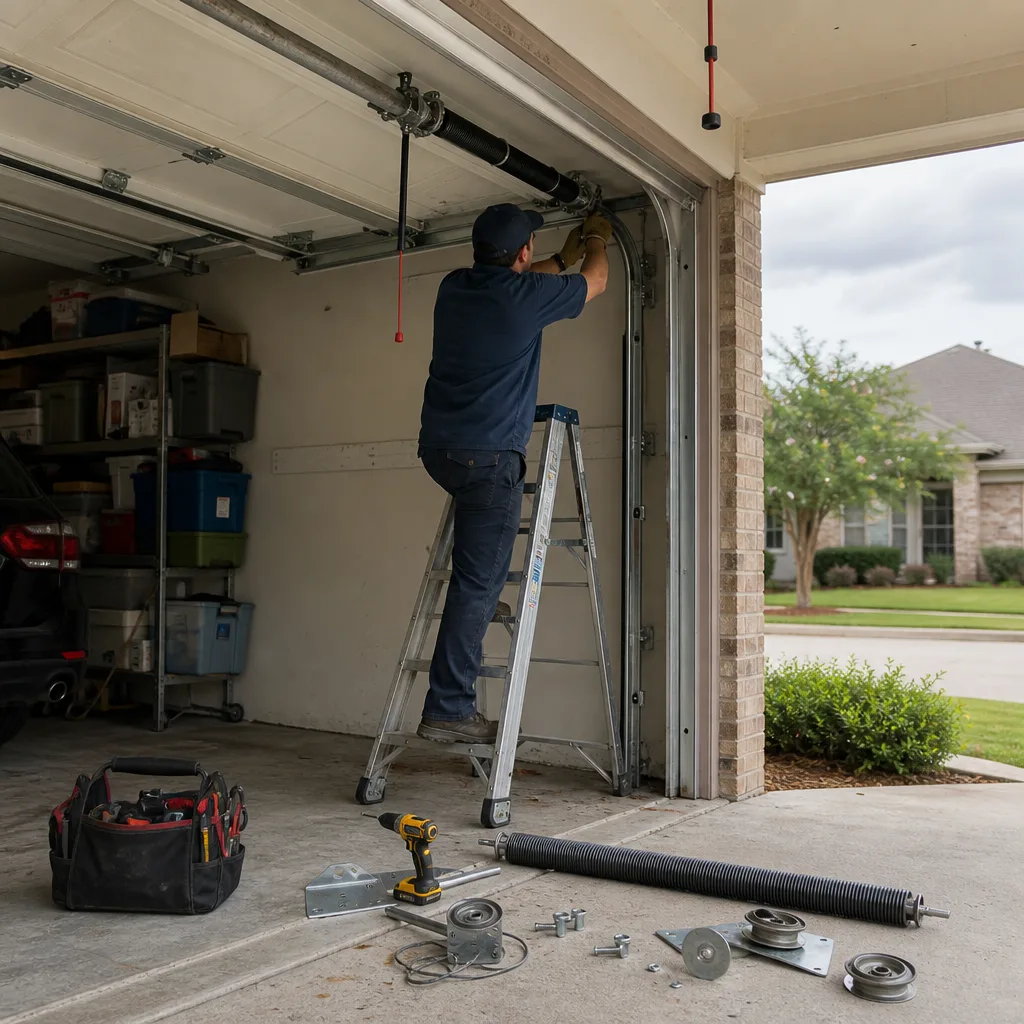
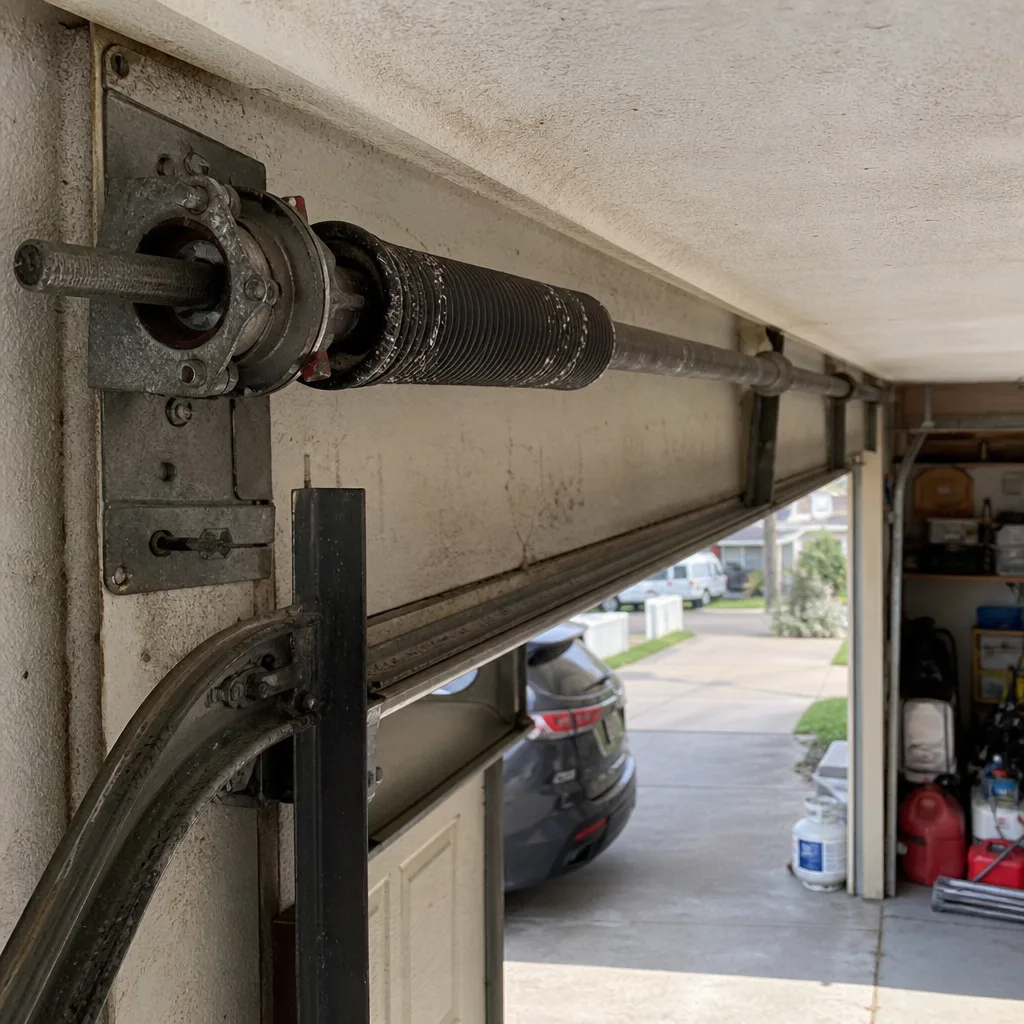
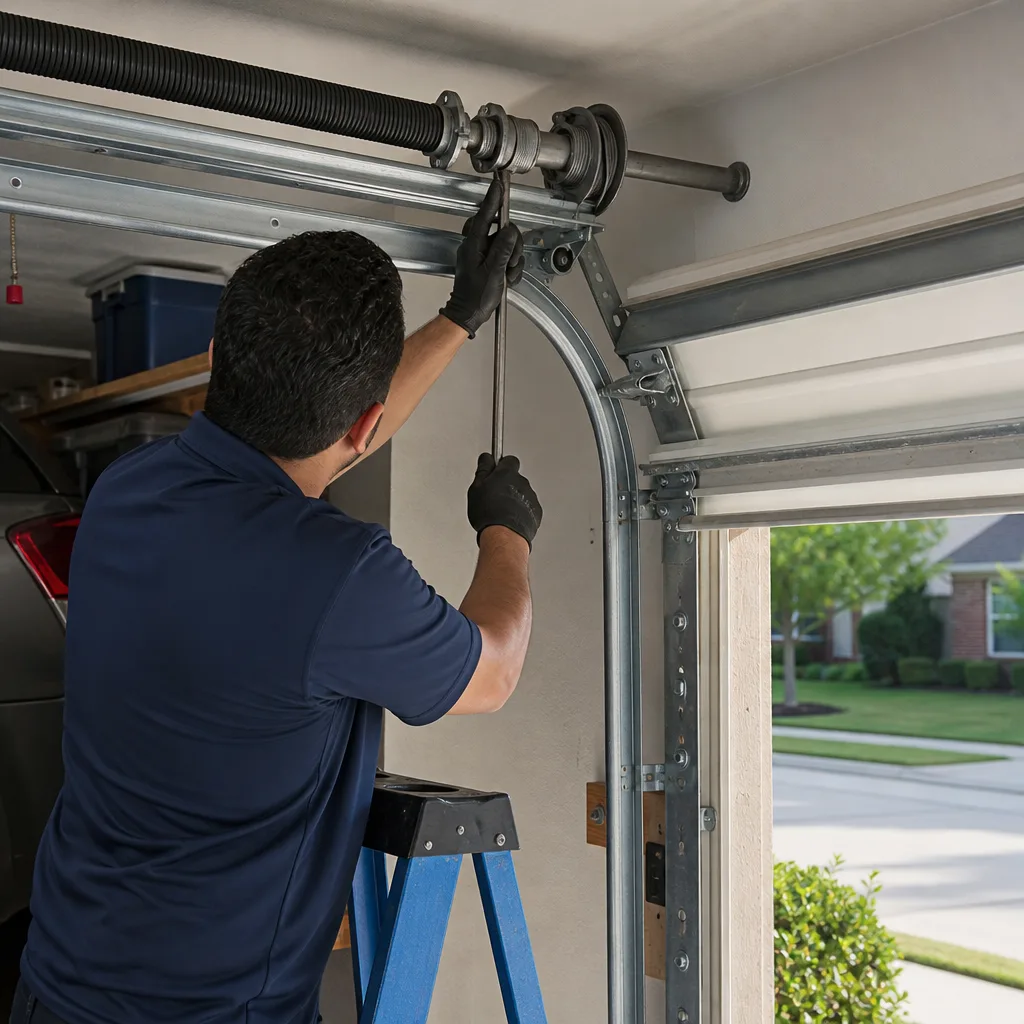
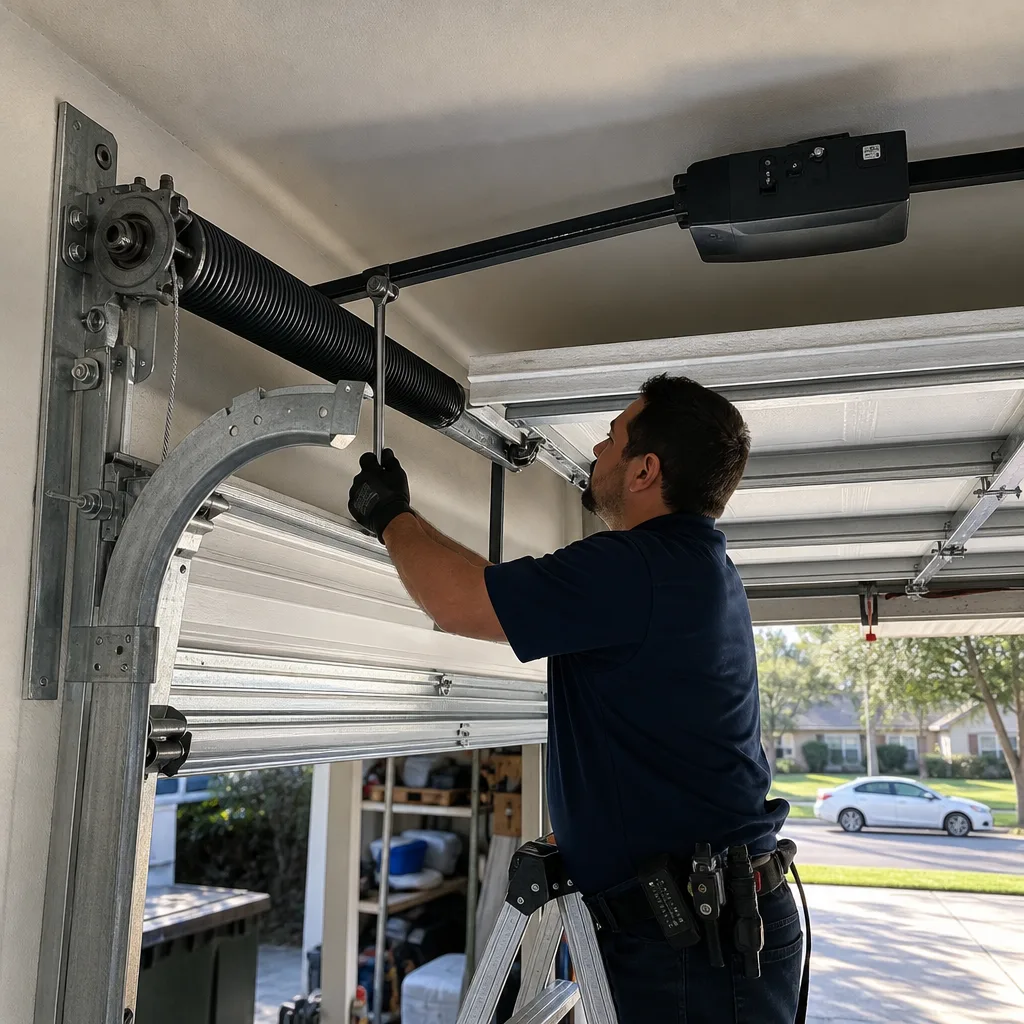
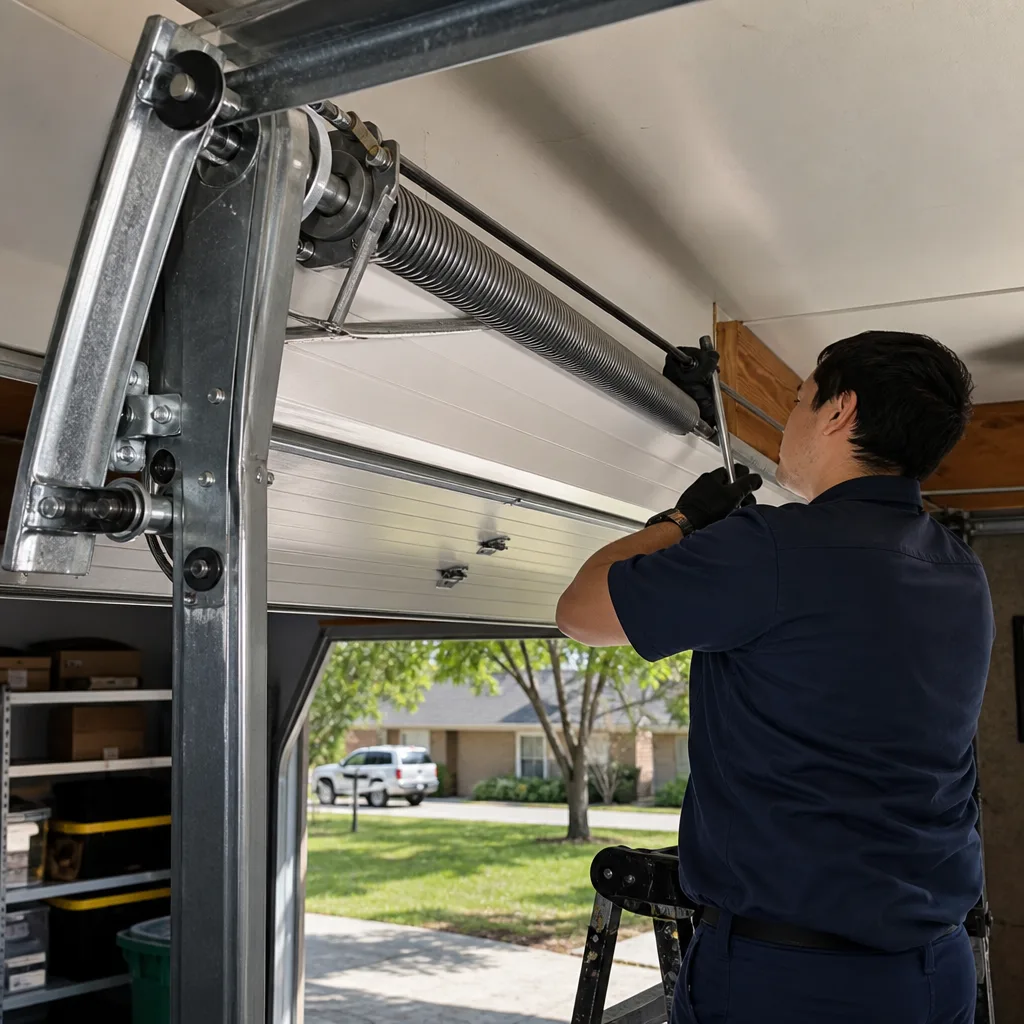
A torsion spring is a thick steel coil mounted horizontally above the door opening. It counterbalances the entire weight of the door. When it breaks, you’ll know because the sound will bring you out of the house thinking something exploded in the garage. Replacing one requires winding the new spring with metal winding bars while it’s under tension, typically 30 to 36 quarter-turns per spring. The winding bars are half-inch steel rods. If one slips out of the winding cone while you’re holding it, it becomes a projectile moving faster than your hand can react. We’ve heard every “I’ll just be careful” speech there is. Careful doesn’t stop a steel bar moving at that speed, and neither does the disclaimer at the beginning of the tutorial. This is the one job in residential construction where Otto will tell you flat-out: the money you save doesn’t cover the risk. And in 21 years, he’s never had a spring-related injury on his crew because his crew uses the right tools and the right technique every single time. If you’re in Sugar Land and a spring breaks, call a professional. A reputable one will quote you a price over the phone and hold to it, whether they’re working in Sugar Creek or New Territory.
Cable Work: The Silent Partner of the Spring
The cables run along both sides of the door and transfer the spring’s force to the door itself. When a cable snaps, the door usually hangs crooked or drops hard on one side. People look at a broken cable and think “it’s just a wire with a loop on the end.” What they don’t see is that the cable was holding the entire weight of the door at the moment it failed. Replacing a cable requires taking tension off the spring system first, which means you’re back to winding and unwinding torsion springs. If the cable itself was damaged while under load, a burr or a sharp kink means it can cut right through a glove or a hand when it slides. This is not a job for a Saturday with a beer in one hand. Leave it.
Track Adjustments and Anchoring: The Structural Line
Your door rides on steel tracks bolted to the wall and ceiling. If the door is binding, squealing, or hanging uneven, the problem might be a track that’s drifted out of alignment. The fix sounds easy: loosen a bolt, tap the track over, tighten it back. The problem is that tracks and springs work as a system. Move a track without understanding how it interacts with the spring tension and the cable geometry, and you can create a situation where the door leaves the track entirely while it’s running. That’s 200 pounds coming down on whatever is underneath it. In Sugar Land, where soil movement means garages shift more than they do in other parts of Texas, track misalignment is often a symptom of a deeper anchoring issue, not just a bent bracket. If you’re hitting the track with a hammer and hoping for the best, you’re past the line.
The Cost Math Done Honestly
We’re going to be straight with you about the math, because most articles and more guides & resources either say “DIY saves money!” or “Always call a pro!” and neither is the whole truth. The honest answer is that it depends on the task, and some DIY attempts have a negative return on investment.
Where DIY Actually Saves Money
These are the tasks where doing it yourself genuinely makes financial sense in Sugar Land:
| Task | DIY Cost | Pro Cost | Savings |
|---|---|---|---|
| Lubricating all moving parts | $8 (grease) | $75-$120 (service call) | $70-$110 |
| Replacing remote battery | $5 | $25-$50 | $20-$45 |
| Replacing bottom seal | $25-$35 (material) | $90-$140 | $55-$105 |
| Cleaning/aligning sensors | $0 | $60-$90 | $60-$90 |
| Buying a new remote (not programming) | $35-$60 (universal) | $75-$120 (with markup) | $40-$60 |
If you do the lubrication and weatherstripping yourself twice a year, you’re saving roughly $150 to $250 a year in Sugar Land. That’s real money, and it’s why Otto tells every customer these four tasks are theirs to own if they want them.
Where DIY Costs More Than Calling the First Time
This is the math people don’t do. Here’s a real pattern we see in Sugar Land neighborhoods like Riverstone and Telfair:
- Attempted spring replacement: Someone buys a $40 spring online, gets the winding bars, and tries it. The spring slips, the door slams down, and the track bends on one side. Now the parts cost is $40, plus a new spring ($80-$120), plus a new track section and brackets ($70-$110), plus the labor to straighten everything out. What would have been a $280-$350 spring replacement is now a $500-$650 job. And that’s the version where nobody gets hurt.
- Attempted cable replacement: You buy a $15 cable, pull the old one off, and the door drops because the tension wasn’t released properly. The door bends, the track kinks, and the opener takes a hit too. Original repair cost: $150-$200. Cost after the DIY attempt: $400-$550.
- Panel dent “fix”: You try to knock out a dent in a panel with a rubber mallet. The panel is aluminum and now it’s creased, which means it’s structurally weakened. A new panel is $350-$500 installed. A pro would have either fixed the dent properly with a panel brace or told you to leave it alone for $0.
The rule is simple: if the task touches a spring, a cable, or the structural integrity of the door, the DIY savings is almost always negative. If it’s lubrication, sensors, batteries, or rubber seals, DIY wins every time.
The “Will the Price Change When They Get Here?” Question
This is the question every Sugar Land homeowner over 50 has already learned to ask, usually after getting burned once. Here’s how it should work: a legitimate garage door company quotes you a price over the phone, gives you the quote in writing, and when the tech arrives, that number doesn’t move unless the scope of work actually changes. If a company won’t quote you over the phone, or says “the tech will assess it on site,” that’s your signal to call someone else. Otto’s Garage Door has been quoting jobs on the phone since 2004, and the price you hear on the call is the price on the invoice. That’s not a sales pitch, it’s a business decision: a customer who knows the number before you show up is a customer who pays without a fight and calls you again next time.
Sugar Land Soil: The Hidden Variable in Every Door Problem
If you’ve lived in Sugar Land for more than a couple of years, you already know about the soil. For everyone else: the Houston area, including Fort Bend County, sits on a mix of clay-heavy soils that expand when they get wet and contract when they dry out. Sugar Land’s specific soil composition makes this worse than in some nearby areas because many neighborhoods were built on what used to be sugarcane farmland, where the soil is particularly high in expansive clay. Homes shift fractions of an inch over months and years. That’s normal. But it means your garage door, which is attached to your house, shifts along with it.
What Soil Movement Does to Your Door
When a garage floor and the walls around it shift at slightly different rates, the door tracks that were installed perfectly level in 2004 might be out of square by 2026. You’ll notice it as a door that rubs on one side, or a gap at the bottom that wasn’t there last year, or a door that feels heavier halfway through its travel. The natural instinct is to fix the symptom: adjust the track, tighten a bolt, shim the sensor. But in Sugar Land, these issues often have an underlying cause that a simple fix won’t address. A track that’s drifted because the wall behind it moved will just drift again if you straighten the track without addressing the anchoring. This is also why sensor misalignment is so common in Sugar Land compared to areas with more stable soil: the entire door assembly moves a tiny amount every season, and the photo eyes are the first thing to fall out of alignment because they sit at the very bottom of the track.
What This Means for Your DIY Decision
If you’re doing basic maintenance and you notice the door is rubbing or binding, don’t assume it’s a quick adjustment. It might be, but it might also be a sign that the door’s anchoring has shifted, and adjusting the track without addressing the anchoring can make the problem worse. This is where a free second opinion from someone who works on Sugar Land doors every day pays for itself. We’ve seen doors in neighborhoods like Sugar Lakes and Colony Bend where a homeowner spent a month adjusting sensors every few days, only to find out the real problem was a garage floor that had settled three-eighths of an inch and the track needed a different anchoring approach entirely.
How to Describe a Problem So You Get an Honest Scope
When you call a garage door company, the quality of the diagnosis you get depends partly on how you describe the problem. A vague “it’s making a noise” call is going to get you a vague answer and probably a larger quote, because the person on the other end is filling in the blanks with worst-case scenarios. Here’s how to describe your garage door problem so you get an accurate quote and an honest scope over the phone:
- Say exactly when it started. “It started grinding three days ago” is more useful than “it’s been making noise.” Fresh problems have different causes than long-standing ones.
- Describe the sound precisely. A grind is different from a pop is different from a rattle. A broken spring sounds like a gunshot. A failing roller sounds like a train going over a track joint. A loose chain rattles. The more precise the sound, the more precise the diagnosis.
- Say what the door does, not just what it sounds like. Does it open but not close? Close but not open all the way? Reverse halfway down? Open an inch and stop? Each of those points to a different system: sensor, spring, opener logic, cable.
- Note if it happens every time or only sometimes. An intermittent problem usually means a part is wearing out. A constant problem usually means something has already failed. That distinction changes the repair approach.
- Mention the door’s age and brand if you know them. A 2004 Craftsman opener has different failure patterns than a 2022 Chamberlain. If you have a Raynor or Amarr door, say so. These details help the person on the phone give you an accurate picture.
A good technician will ask follow-up questions after you give them the basics. If the person you’re talking to doesn’t ask any questions and just says “we’ll send someone out,” be wary. That’s a company that’ll quote high on the assumption they’re replacing everything, because they haven’t done any actual diagnosis. Otto answers the phone himself in Sugar Land most days, and he’ll ask you the questions that matter before he gives you a number, because he’d rather quote the right repair than a shotgun job that replaces parts that didn’t need replacing.
Common Mistakes to Avoid
- Using WD-40 on garage door parts. It’s a solvent, not a lubricant. It strips the grease off your hinges and springs, which means the door actually gets worse after you spray it. Use white lithium grease or a garage door-specific lubricant instead.
- Disconnecting the opener with the door up and the spring broken. When a spring breaks, the door is no longer balanced. If you pull the red release handle while the door is in the up position, that 200 pounds is coming down fast, and you’re standing under it. If a spring breaks in your Sugar Land garage, leave the door where it is and call a pro.
- Assuming the opener is the problem when the door is heavy or straining. The opener motor only moves the door. It doesn’t carry the weight. If your opener is grinding or struggling, the problem is almost always the spring or the rollers. Replacing the opener without fixing the spring means you’ll be replacing the opener again in a year. This is the most common misdiagnosis we see in Sugar Land.
- Buying “universal” parts online without checking compatibility. Not all bottom seals fit all doors. Not all remote controls work with all openers. The $8 universal seal that doesn’t fit is an $8 loss plus the cost of buying the right one anyway.
- Ignoring a door that’s “a little bit off” for months. That slight unevenness or that small rub on one side is a symptom. In Sugar Land’s shifting soil, it tends to get worse, not better. Catching a track issue early costs $100. Waiting until the door comes off the track costs $500 or more.
- Hiring a company that won’t give you a phone quote. If they “need to see it in person before they can give you a number,” you’re going to get the high end of whatever range they eventually quote. A reputable company quotes on the phone and holds to it unless the scope genuinely changes.
- Treating garage door springs as a “might as well replace both while I’m at it” job. Actually, this one’s correct: when one spring breaks, the other one isn’t far behind, and replacing both in one visit costs less than doing them separately. But some companies use this to upsell you on the second spring when you only asked about one. The right move is to replace both when one breaks, but get the pricing for both upfront so you know what you’re authorizing.
When to Call a Professional
Here’s the short version: if the job involves a spring, a cable, or anything that holds tension, call a professional. If the door is off its tracks, call a professional. If the door won’t open and you need your car to get to work in the morning, call a professional. In Sugar Land specifically, if your door problems started after a long dry spell followed by heavy rain, you’re likely dealing with soil movement that’s shifted your door’s alignment, and that’s a diagnosis a pro should make before you start adjusting things. Otto’s Garage Door offers free estimates in Sugar Land, and the price you get on the phone is the price you’ll see on the invoice. Call (346) 484-4781 and describe what’s happening. You’ll get a straight answer even if the answer is “you can do that yourself.”
Frequently Asked Questions
Torsion spring replacement in Sugar Land typically costs $280 to $350 for a single spring or $350 to $450 for both springs on a standard 7-foot residential door, including parts and labor. For full pricing context, see our Garage Door Cost Breakdown: The Sugar Land Homeowner’s Reference for 2026. Two-spring systems on heavier or double-wide doors run higher. If a contractor quotes significantly less than that, ask whether the spring is a standard spring or a high-cycle spring; high-cycle springs cost more upfront but last three to four times longer in Sugar Land’s climate. Call (346) 484-4781 for an exact quote on your door.
No. Torsion springs are under extreme tension and the winding tools can slip and cause severe injury, including broken bones and deep lacerations. This is the one garage door repair where every experienced professional gives the same answer: do not attempt it yourself. The cost of a professional replacement is a fraction of what a hospital visit costs, and that’s before you account for whatever damage the door does when it drops.
Lubricate your garage door hinges, rollers, and springs every six months in Sugar Land. The humidity here means metal components rust faster than in drier parts of Texas, and regular lubrication extends the life of your rollers and springs by years. It’s a 15-minute job that costs about $8 in materials.
A door that reverses as it’s closing is almost always a photo-eye sensor issue. The sensors at the bottom of the track are either misaligned, dirty, or blocked. In Sugar Land houses with west-facing garages, late afternoon sun can also blind the sensors and cause the reversal. Clean the lenses, check the alignment, and shade the sensor from direct sun if the problem only happens at certain times of day.
A reputable company will not. You should get a price over the phone, and that price should hold when the technician arrives unless the scope of work genuinely changes. If a company refuses to quote on the phone or says “the tech will assess it on site,” that’s a red flag that you’ll be quoted high once they’re standing in your driveway. Otto’s Garage Door quotes every job on the phone and holds that number.
Usually not. A noisy opener is often a symptom of a problem elsewhere in the door system: worn rollers, a dry chain, an unbalanced spring, or a loose mounting bracket. Those issues will make a brand-new opener noisy too if they’re not fixed. Diagnose the actual cause before you spend $400 on a new unit. If your garage door opener in Sugar Land is genuinely failing, garage door opener repair is often more cost-effective than replacement, especially on units under ten years old.
The Bottom Line
The DIY-versus-professional decision for your garage door comes down to one rule: if it holds tension or carries weight, it’s not a DIY job. Lubrication, sensor alignment, battery changes, and weatherstripping are all legitimate homeowner tasks that save you $150 to $250 a year in Sugar Land. Springs, cables, and track anchoring are professional jobs where the DIY attempt almost always costs more than the original repair would have, plus the real risk of injury. Sugar Land’s expansive soil adds a variable most national guides ignore: your door shifts over time, and symptoms that look simple often have structural causes that need a trained eye. Whether you’re handling the maintenance yourself or calling for a repair, garage door repair in Sugar Land should start with an honest conversation and a phone quote that doesn’t move. Otto’s Garage Door has been doing it that way since 2004, serving homeowners throughout Fort Bend County with the same straightforward approach. For a free estimate, call (346) 484-4781. And if you’re ever not sure whether a job is safe to do yourself, call and ask. The answer costs you nothing.
Written by Otto Reinhardt, Owner at Otto’s Garage Door home, serving Sugar Land since 2004.