
Last updated September 10, 2026
Full 25-point door and opener safety check with every visit - springs, cables, rollers, tracks, and your LiftMaster or Chamberlain opener included
You get a price before we start. It does not change when the truck arrives.
 Before
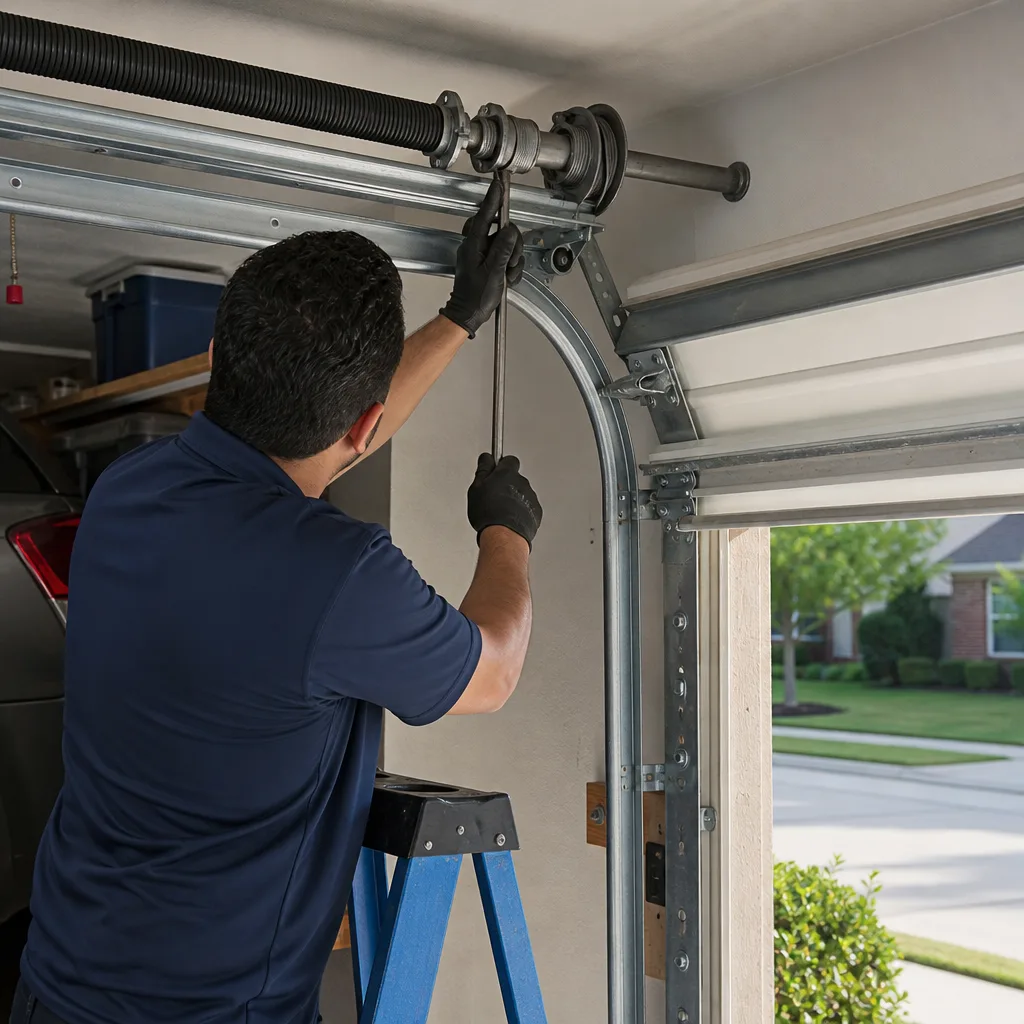 After
After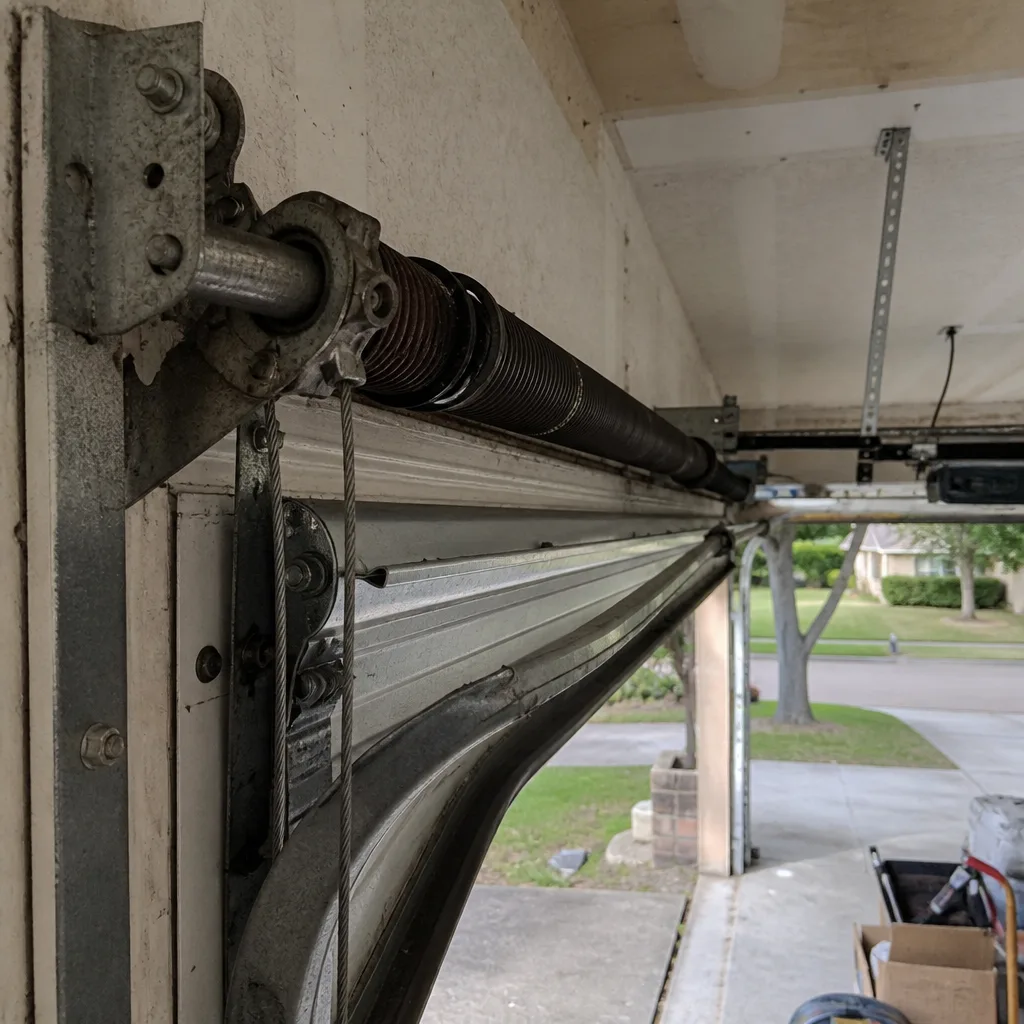 Before
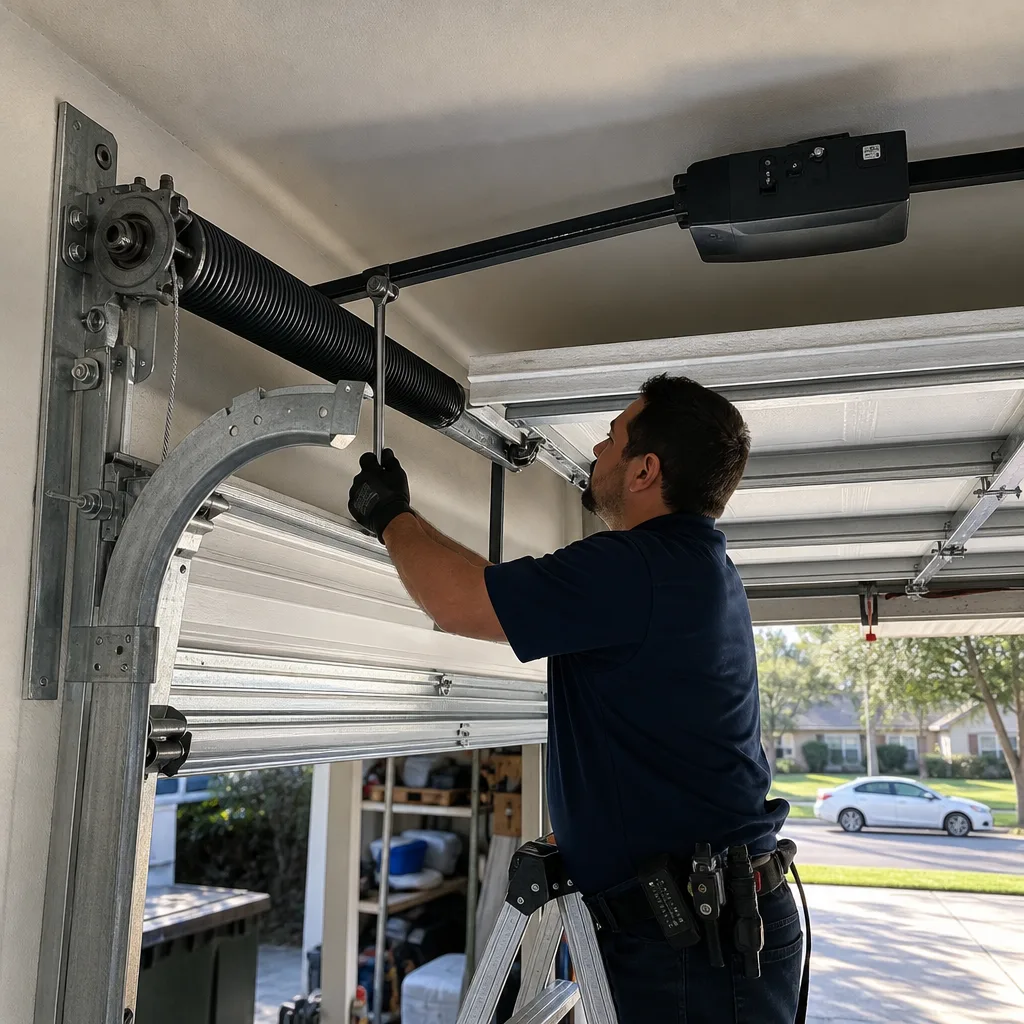 After
After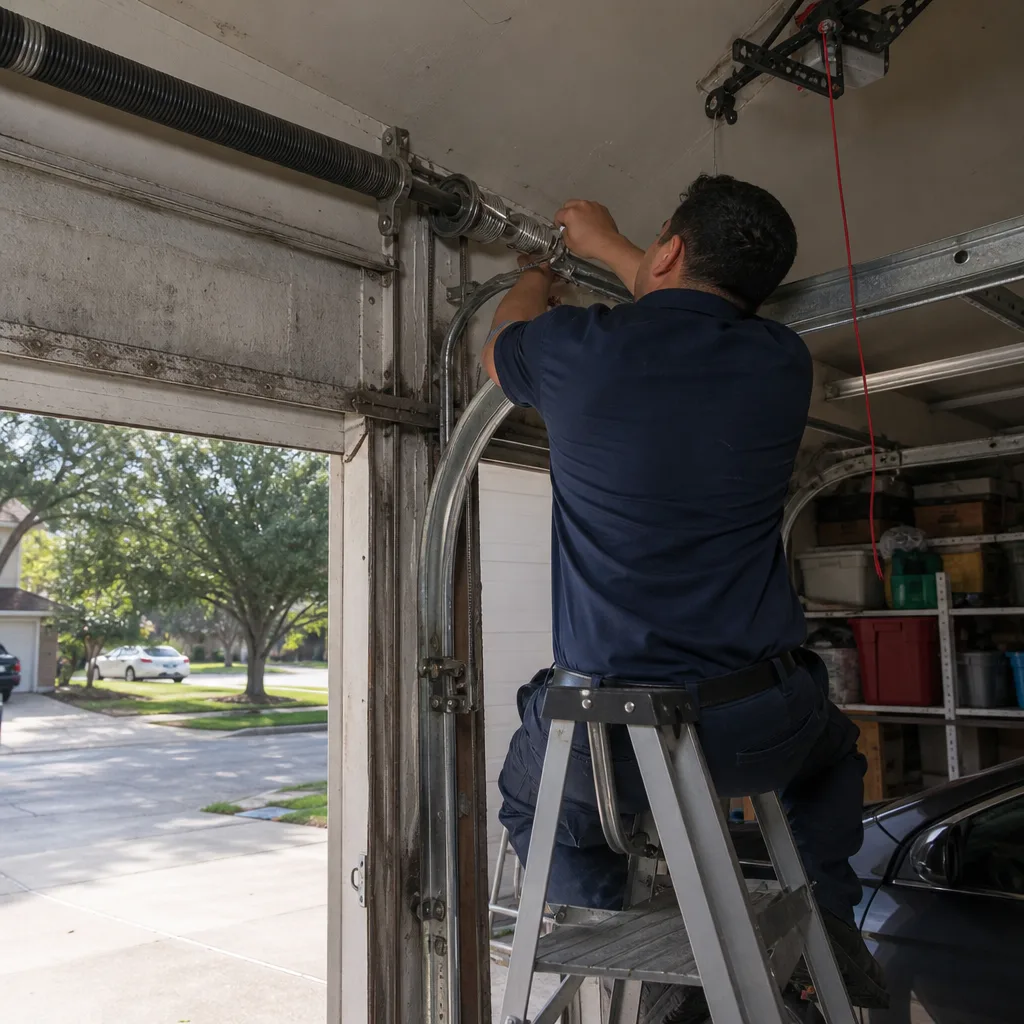 Before
 After
AfterGarage Door Repair Maintenance Checklist for Sugar Land Homeowners
Otto replaced 34 torsion springs last summer alone, and 28 of those homeowners had no idea a spring was in trouble until the door refused to open at 7 a.m. on a workday. Every single one of those failures had a warning sign three to six months earlier. This checklist is built from what we actually find broken on Sugar Land driveways, not from a generic maintenance PDF with the city name pasted on top. You’ll learn the month-by-month tasks, the exact lubrication points that matter in coastal humidity, how to spot a dying spring before it snaps, and which items genuinely need a trained eye versus the ten-minute checks you can do yourself. For a deeper look at what to watch for, see our Garage Door Warning Signs: A Sugar Land Homeowner’s Reference Guide.
Quick Answer
The core garage door maintenance checklist for Sugar Land homeowners boils down to four things: lubricate the rollers, hinges, and springs every three months with a silicone or lithium-based spray (never WD-40), tighten loose hardware twice a year, inspect and replace the bottom seal every two to three years because Sugar Land humidity and hot asphalt accelerate rubber breakdown, and test the auto-reverse safety sensors monthly. Do a full pre-hurricane-season inspection in May and a post-summer heat check in October. Most doors in this climate need spring replacement every seven to ten years, and the warning signs show up long before the snap.
Table of Contents
- The Sugar Land Month-by-Month Maintenance Calendar
- Lubrication Points That Rust Fastest in High Humidity
- How to Spot a Spring That’s Losing Tension Before It Snaps
- Bottom Seal and Weatherstripping: The Sugar Land Rain and Heat Problem
- The 10-Minute Quarterly Walkthrough Any Homeowner Can Do
- Annual Items That Need a Trained Eye
- Opener-Specific Maintenance Most Checklists Skip
- Common Mistakes That Shorten Door Life in Sugar Land
- When to Call a Professional
- Frequently Asked Questions
- The Bottom Line
The Sugar Land Month-by-Month Maintenance Calendar
A garage door does not wear evenly through the year in Sugar Land. Humidity spikes in the spring, heat soaks everything from June through September, and the Atlantic hurricane season runs from June 1 to November 30, with the Texas coast catching most of its activity between August and October. That calendar dictates when you check what. Here’s the rhythm we recommend to customers across Fort Bend County.
January and February: The Cold Snap Check
Sugar Land does get real cold fronts, and steel tracks contract when temperatures drop. That contraction shows up as a door that hesitates or jerks on the way up. Run the door through a full cycle and watch for any pause, shudder, or change in sound. If it struggles in the cold, the problem is usually one of three things: dry rollers, slightly misaligned tracks, or a spring that has lost tension and only shows it when metal tightens up. Tighten the track bolts and bracket screws now while it’s cool enough to work comfortably. Check the weatherstripping along the sides for gaps that let January wind whistle through.
March and April: Humidity Pre-Season
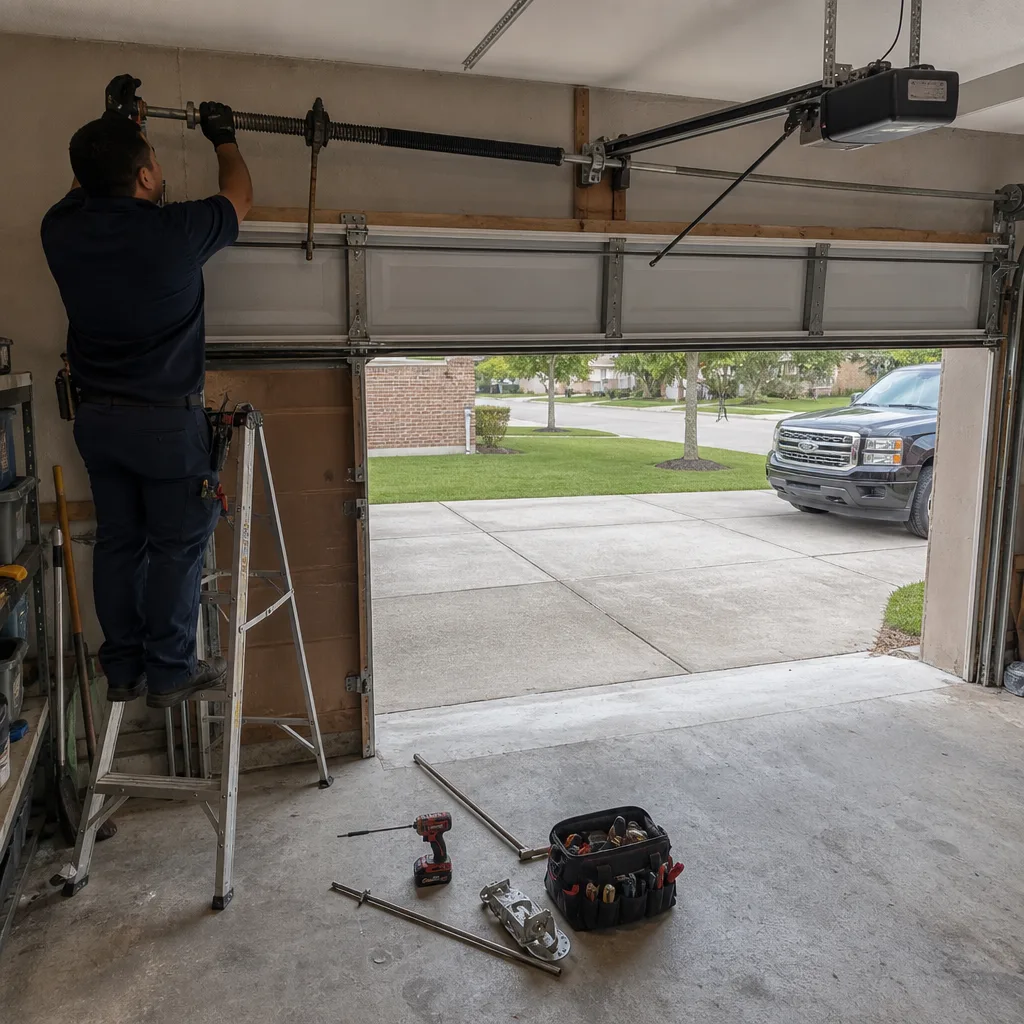
This is when Sugar Land’s humidity starts climbing back into the high numbers, and that means one thing for your door: rust moves fast. Give every metal pivot point a good cleaning and fresh lubrication before the humidity locks in. Inspect the torsion springs above the closed door for any orange or brown surface rust. Surface rust on a spring is not a death sentence, but it should tell you that the spring’s protective coating is gone and the metal is now aging faster. April is also the right time to check your door balance by pulling the release handle and lifting the door manually to about waist height. A balanced door stays put. A door that drifts down or wants to fly up means the spring is wearing out.
May: Pre-Hurricane-Season Inspection
Do this before June 1. Every Sugar Land homeowner should treat May as garage door month. Walk through the full checklist: balance test, safety sensor test, track inspection, roller inspection, cable inspection, bottom seal check. Look at the cables running along each side of the door. Fraying cables are a catastrophe waiting to happen, because when a cable snaps, the door can come down off-balance and cause real damage or injury. If you see one or two broken strands, replace the cable now, not in August when you’re boarding windows and the door is holding your only working vehicle inside. Check that the opener’s emergency release cord is intact and that you know how to operate it manually if the power goes out.
June through September: Deep-Summer Monitoring
Heat does two things to garage door springs in Sugar Land. The first is thermal expansion: metal expands in 100-degree garage interiors, and that changes the effective tension on the spring. The second is accelerated fatigue on the metal’s internal structure. Springs are rated in cycles, and a cycle is one full open and one full close. Most standard torsion springs are rated for 10,000 cycles, which translates to about seven to ten years for a typical homeowner. But sustained heat exposure, especially in west-facing garages that bake all afternoon, can shave real time off that number. During the summer months, listen for new sounds. A creak that wasn’t there in April, a popping sound during travel, a door that’s slower on the way up than the way down. These are all early warnings.
October: Post-Summer Heat Check
After the summer heat has done its work and before the holiday season brings family and out-of-town guests, do a second full inspection. The October check catches what the summer heat broke: stretched springs, cracked rollers, seals that baked and lost flexibility. This is also when we see the most garage door service calls in Sugar Land, and a lot of them are from homeowners who skipped the May inspection and are now discovering symptoms that started months earlier. October is a good time to schedule any repair before the December rush. If you notice anything questionable in this check, call us. A garage door repair in Sugar Land that gets caught in October costs a fraction of an emergency repair on Thanksgiving morning.
November and December: Holiday-Readiness
Beyond the basic monthly checks, November is when you should test the door three times in a row under normal use. Three consecutive smooth cycles tells you the door, spring, and opener are working together correctly. Check that the opener’s force settings are properly adjusted by placing a 2×4 flat on the ground under the door and closing it. The door should reverse within a second or two of hitting the wood. If it keeps pressing, that’s a safety issue that needs immediate attention, especially with kids and grandkids around during the holidays.
Lubrication Points That Rust Fastest in High Humidity
Sugar Land’s humidity is not a background detail; it’s the primary driver of garage door wear in this area. Homes from First Colony to Riverstone to New Territory all deal with the same thing: metal garage door components that start rusting the moment their factory coating wears thin. Lubrication is the cheapest insurance you can buy, but only if you use the right product on the right parts at the right frequency.
The cardinal rule: never use WD-40 on garage door components. WD-40 is a solvent and water displacement formula, not a lubricant. It will clean old grease off and leave the metal drier than before. In Sugar Land’s environment, that means faster rust. What actually works is a white lithium grease for metal-on-metal contact points and a silicone spray for plastic parts, weatherstripping, and rollers with nylon bearings.
The Exact Points That Need Lubrication Every Three Months
- Hinges. Every hinge on every panel. Sugar Land humidity attacks these first because they flex constantly and their factory grease breaks down fast. Place the nozzle at the hinge pivot point and give it a quick spray. Wipe away excess so dust and grit don’t stick.
- Rollers. The wheels that ride in the tracks. Metal rollers with bearings need the bearing lubricated, not the wheel surface. If you have nylon rollers, lubricate the bearing stem only. Do not lubricate the track itself; that creates a greasy mess that attracts grit and makes the door harder to move.
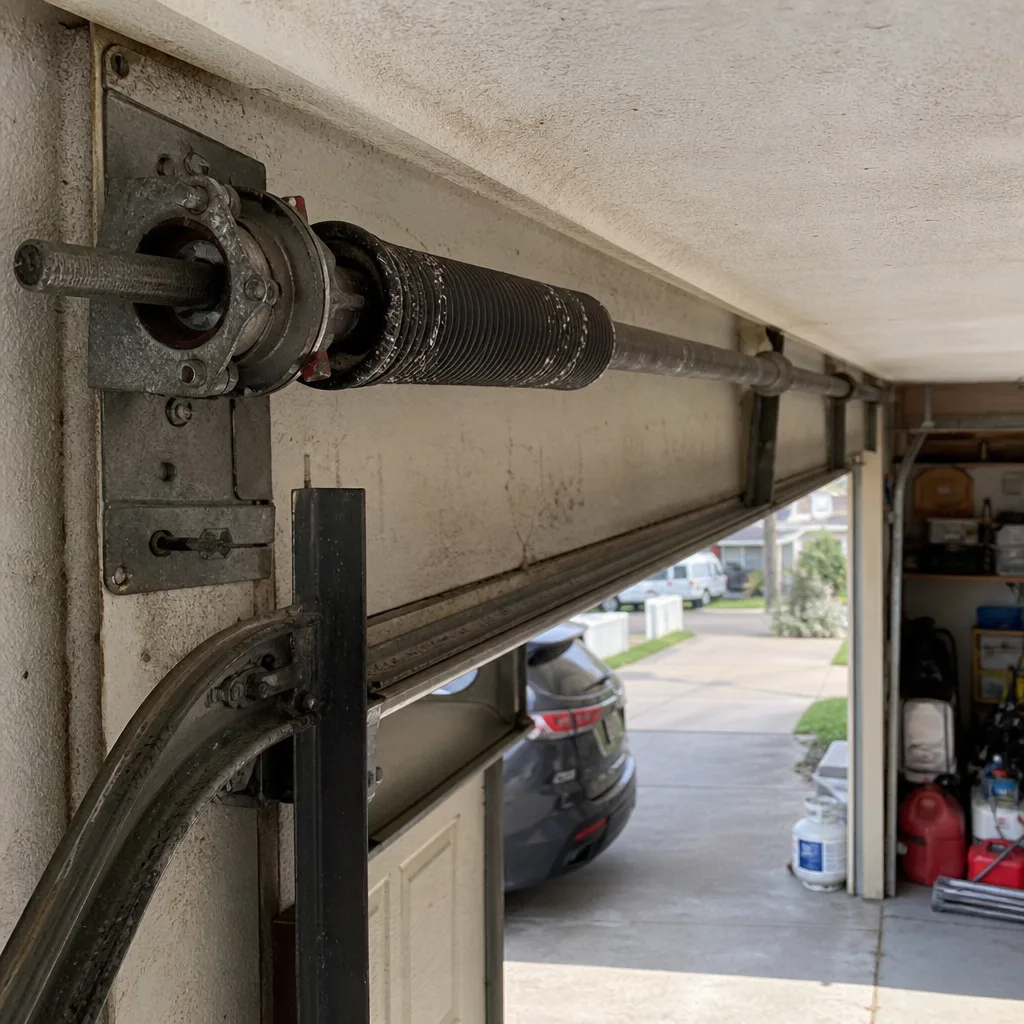
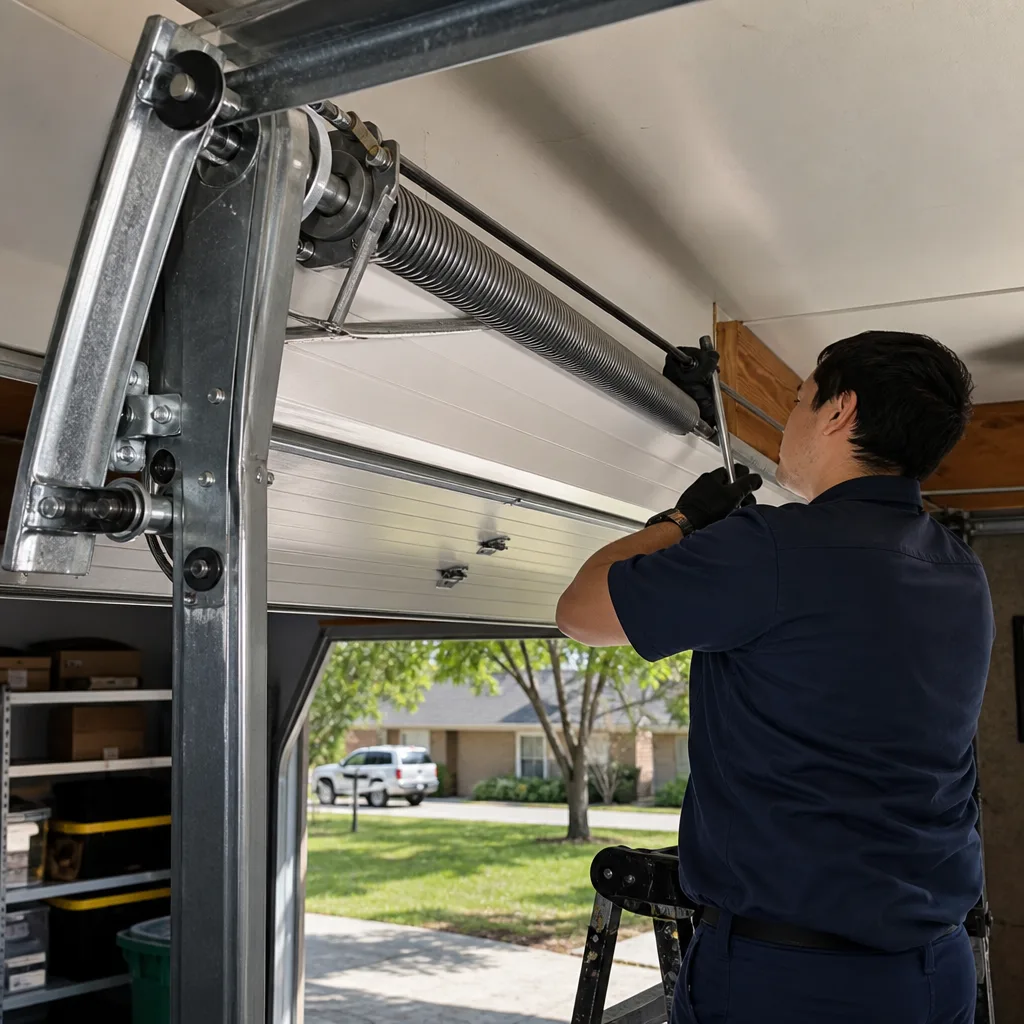
- Torsion springs. These sit above the closed door. Spray the entire length of each spring with lithium grease or a spring-specific coating. This displaces moisture and creates a barrier against rust. The springs flex under enormous tension, and keeping them coated extends their cycle life measurably in humid climates.
- Bearing plates. The steel plates at each end of the torsion tube. These carry the load of the spring assembly and rust gives them a rough surface that adds friction. A quick spray each quarter keeps them smooth.
- Lock mechanism and handle. If your door has a manual lock, the internal mechanism rusts shut in coastal air. A shot of lithium grease twice a year keeps the key turning.
What you’re really doing with quarterly lubrication in Sugar Land is not making the door quieter, though it does that too. You’re creating a moisture barrier. That barrier is what prevents the rust that eats springs, seizes bearings, and turns minor wear into a full garage door opener or door replacement job. Three minutes of spraying every season beats a $300-plus repair every single time.
How to Spot a Spring That’s Losing Tension Before It Snaps
A door is 200 pounds riding on two springs. Respect it. When a torsion spring snaps in Sugar Land, it sounds like a gunshot in the garage, and it almost always happens when the door is closed and you’re about to leave for work. The good news is that springs telegraph their failure for months. You just have to know what you’re looking at and listening for.
Visual Cues on the Spring
When the door is closed, look at the torsion springs mounted above the door. A healthy spring is a tight, continuous coil with no visible gaps between the segments. A failing spring starts to develop a visible gap, usually in one or two spots along its length. That gap means the metal has stretched and the coil is no longer uniform. It’s the single clearest sign a spring is in its last season.
Also check for rust that’s deeper than surface orange. If you see flaking, pitting, or rust that crumbles when touched, the spring’s structural steel is compromised. We have replaced springs in Sugar Land that looked fine from three feet away but had rust pits deep enough to be visible from a foot. Those always snap earlier than their cycle rating would suggest.
Sound Cues During Operation
Run the door through a full cycle and listen. A healthy torsion spring makes almost no sound. A failing spring announces itself:
- A creaking or groaning sound during the first third of the opening cycle means the spring is binding internally.
- A popping sound at a specific point in the travel usually means a coil has shifted or the spring is beginning to separate from its anchor.
- A rattle from the spring area when the door is closed and you tap the spring lightly with a broom handle suggests the spring has lost tension and is now loose on the shaft.
The Balance Test: The Most Reliable Diagnostic
- Close the door completely.
- Pull the red emergency release handle on the opener. This disconnects the door from the opener carriage.
- Lift the door manually to about waist height and let go.
- Watch what happens.
A door with healthy springs holds its position at waist height. A door that drifts down toward the floor has springs that are losing tension. A door that wants to rise on its own has springs that are still strong but may be overpowered for the door’s weight, which happens when a prior repair used the wrong spring. Either way, the fix is spring work, and spring work is not a DIY job. The tension stored in a garage door spring is enough to cause serious injury or death if it releases unexpectedly. This is a time to call a professional, and in Sugar Land that call should be to someone whose name you can verify before the truck arrives. Otto’s Garage Door home has served Fort Bend County since 2004, and Otto counts spring cycles the way you count tire miles.
We recommend checking balance quarterly. In Sugar Land’s climate, we see springs in west-facing garages lose tension measurably faster than identical springs in shaded north-facing doors. Heat is not your spring’s friend, and the sun on a garage door all afternoon raises the interior temperature enough to accelerate metal fatigue over a decade of summers.
Bottom Seal and Weatherstripping: The Sugar Land Rain and Heat Problem
The bottom seal on your garage door does more work in Sugar Land than in most places. It has to hold back torrential spring downpours, summer sun that heats the concrete pad to 130 degrees or more, and the fine silt that drifts in from construction sites across Fort Bend County’s growing suburbs. Most factory seals, especially on doors installed ten or more years ago, are not up to that job indefinitely. A failed bottom seal lets water pool at the base of the door, wicks moisture into the bottom panel, and accelerates rust on the door’s lower hardware.
Here’s the cadence we recommend for Sugar Land homeowners:
- Check the seal visually every month. Lie down or kneel and look at the rubber strip along the bottom of the closed door. You’re looking for flattening, cracks, gaps where the seal no longer touches the concrete, and spots where the rubber has been crushed permanently by the weight of the door.
- Do the daylight test every quarter. Close the door and turn off the garage lights. Look for daylight visible under the bottom of the door. Any visible light means water, dust, and pests can get in. Sugar Land mosquitoes and heavy rain don’t need an invitation.
- Plan to replace the seal every two to three years. Hot asphalt driveways radiate heat upward, and rubber compounds that bake at 130-plus degrees lose flexibility faster than the seal’s rated lifespan suggests. A seal that looks fine in October may be hard and cracked by the following June.
- Check the side weatherstripping annually. The vertical strips that run along the sides of the door degrade from UV exposure, especially on south-facing doors. Gaps here let conditioned air escape and humidity in, which raises your electric bill and accelerates rust on tracks and hardware.
Replacing a bottom seal is one of the few garage door maintenance tasks a careful homeowner can do themselves. You pull out the old seal from the retainer channel at the bottom of the door, slide in the new one, and cut it to length. But the job goes sideways fast if the retainer channel itself is corroded, which we see often in Sugar Land because of the humidity. If the channel is pitted or rusted through, the door itself may need work, and that’s not a good weekend project. For that, or for a full door replacement with modern seals, call a garage door installation in Sugar Land shop that will quote the work before any part is ordered.
The 10-Minute Quarterly Walkthrough Any Homeowner Can Do
You don’t need a tool bag for this. Ten minutes, four times a year, and you’ll catch most garage door problems before they become emergencies. Here’s the exact sequence:
- Stand in the driveway and look at the door. Is it level? A door that sits slightly lower on one side than the other has a cable issue, a spring issue, or a track issue. When the door is open, does it sit straight along the horizontal track? Sagging on one side means something is unevenly worn.
- Open and close the door while watching the rollers. Rollers should roll inside the track. If a roller is sliding instead of rolling, the bearing is seized and the roller is grinding a flat spot into itself. A flat spot on a roller becomes a bump you feel every time the door passes that point.
- Listen to the full cycle. A consistent, even hum is normal. Clanks, pops, groans, or a hissing sound are not. Mark the rough location of any odd sound and mention it to whoever looks at the door next.
- Check the safety sensors. Wave your hand in front of the sensor beam while the door is closing. The door should stop and reverse immediately. Test both sides. Clean the lens covers with a dry cloth; Sugar Land’s fine dust and occasional mold spores cloud these over time.
- Tighten what you can reach. Grab a wrench and check the bolts on the track brackets, the hinges, and the opener mounting. Vibration works these loose over months of daily cycles. Loose hardware causes alignment drift, and alignment drift causes everything else.
- Look at the springs, cables, and pulleys. Specifically, look for rust on the springs, frayed strands on the cables, and any visible wear on the pulleys. If a cable looks even slightly fuzzy where individual strands are separating, flag it.
That’s the whole routine. Ten minutes, once a quarter, and you will not be one of the 28 homeowners Otto added to his spring-replacement count last summer who had no idea anything was wrong.
Annual Items That Need a Trained Eye
The quarterly walkthrough catches a lot, but some things genuinely need someone who looks at garage doors every day. Otto’s crew has been running our Garage Door Repair services across Sugar Land since 2004, and these are the items we tell homeowners to leave to us.
Torsion Spring Calibration and Cycle Count
A spring’s cycle rating is a real number, and a trained eye can estimate remaining cycles by measuring the spring’s length under load and comparing it to the manufacturer’s spec for that diameter and wire gauge. This is not guesswork; it’s a measurement. If you’re at 70 percent of your spring’s rated life, we’ll tell you what’s left and quote a replacement on your schedule, not on an emergency timeline. Most Sugar Land homeowners get seven to ten years out of a standard 10,000-cycle spring under normal use, and shorter life from springs on doors that face west and bake in afternoon sun every day of the summer.
Track Alignment and Level
Track alignment drifts over time as the house settles and the door rack cycles thousands of times per year. When tracks are out of level by even a quarter inch, the door’s weight distribution changes, and that changes how fast the springs and cables wear. Checking alignment properly means measuring the distance between tracks at the top, middle, and bottom of the vertical run, and confirming the horizontal tracks are level with a real level, not an eyeball. This is a five-minute job with the right tools and a frustrating hour without them.
Opener Force and Travel Settings
Every opener has a force adjustment that controls how hard the motor pushes and pulls. Over time, as the door’s balance shifts, the motor may work harder than it should. A trained technician can set the force correctly so the motor is not burning itself out prematurely. LiftMaster, Chamberlain, and Genie openers all have slightly different adjustment procedures, and setting force too high is a safety issue: the door should reverse when it meets resistance, not push through it.
Spring Pad and Bearing Plate Inspection
The bearing plates at the ends of the torsion tube carry the entire load of the spring system. When these wear out, the tube can wobble under load, and that wobble accelerates wear on everything connected to it. This inspection requires looking closely at components most homeowners never even see, and we haven’t met a homeowner yet who wanted to spend their Saturday afternoon lying on a garage floor staring up at a torsion tube.
These annual items are not upsells. They’re the reason some Sugar Land doors last 25 years while others need major work at 12. The difference is rarely luck. It’s usually whether someone caught the small stuff before it became the big stuff.
Opener-Specific Maintenance Most Checklists Skip
If the opener is straining, the problem is almost never the opener. That’s one of Otto’s standing lines, and it’s true more often than not. An opener that seems weak, slow, or noisy is usually fighting a door that’s out of balance, tracks that are out of alignment, or springs that have lost tension. The opener is the messenger, and it’s getting blamed for the message.
What to Check on the Opener Itself
- Chain or belt tension. A loose chain sags and slaps against the rail. A loose belt slips and jerks. Both produce noise and accelerate wear on the drive sprocket. Proper tension is a half-inch to three-quarters of an inch of play at the midpoint, and adjustment is a quick job for someone who knows the correct spec for your brand. We train across LiftMaster, Chamberlain, Genie, Clopay, and the rest of the major brands.
- Safety sensor alignment. If the sensors are even slightly out of alignment, the door will refuse to close or will reverse for no apparent reason. This shows up more in Sugar Land in late summer when concrete expands and shifts slightly. Realigning sensors is a two-minute fix, but it requires patience to get the brackets level and the beams perfectly aligned.
- Emergency release cord. Pull it once a year to make sure it still disconnects smoothly. A corroded release mechanism is a real problem during an extended power outage before or after a hurricane, exactly when you need the manual operation to work.
- Opener logic board and capacitor. These are not homeowner-check items. If the opener is behaving erratically, running when no one pressed a button, or making a clicking sound without moving, the logic board or capacitor may be failing. On an older unit, the cost of the board often pushes you toward a new opener, and we’ll tell you straight which way makes sense.
One more Sugar Land-specific note: garage interiors here get hot. Openers mounted in uninsulated garages run at temperatures that stress the motor windings and shorten capacitor life. If your garage gets direct afternoon sun on the door, you can expect your opener to age faster than the manufacturer’s stated lifespan. Keeping the door spring-balanced so the opener isn’t working hard against a weak spring is the single best thing you can do for the opener’s longevity. For replacement, the decision tree is simple: if the opener is more than 12 to 15 years old and doing anything weird, replacement is usually the better value than repair. And with a new opener, you get modern safety features and a warranty that starts fresh.
Common Mistakes That Shorten Door Life in Sugar Land
- Skipping spring lubrication until there’s rust you can see. By the time rust is visible on the spring, the protective coating is already gone and the metal has started degrading. Quarterly lubrication prevents that from happening in the first place. A rusted spring is closer to the end of its life than its age suggests.
- Using WD-40 as a lubricant. This is the most common mistake we see in Sugar Land driveways. WD-40 strips existing lubrication and leaves metal vulnerable to humidity. Use white lithium grease on metal and silicone spray on plastic and rubber.
- Power-washing the garage door with high pressure. Pressure washing drives water into the panel joints, the weatherstripping channels, and the spring hardware. In Sugar Land’s humidity, that water doesn’t dry quickly, and it accelerates rust exactly where you don’t want it. Use a garden hose and a soft brush instead.
- Ignoring a door that’s slightly slower on one side. That asymmetry is the first sign of a cable, spring, or track problem. If you notice the door hesitates or seems to lead with one side, don’t wait to see if it gets better. It won’t.
- Replacing the opener when the real problem is the spring. We see this all the time. A homeowner calls about a door that won’t open, assumes the opener is dead, and replaces it, only to have the same problem return when the spring fails completely. Before you replace an opener, check the door’s balance. If the door won’t stay up at waist height when you lift it manually, the spring is the problem, not the opener.
- Adjusting cables or springs as a DIY project. The cables hold the door’s tension. The springs store enough energy to seriously injure you. There is no version of this story where a homeowner saves money by attempting a cable or spring repair themselves. The tools, the training, and the safety equipment all matter.
- Neglecting the hurricane-season check because the door still opens. The door will keep opening right up until the morning it doesn’t. The pre-June inspection catches the problem while you still have time to schedule a repair on your terms, not in the middle of a storm prep scramble with five other households calling the same shop.
When to Call a Professional
Some garage door work is homeowner territory: lubrication, hardware tightening, seal inspection, sensor cleaning. Some is not. If your door fails any of these tests, call a pro before the problem gets worse. A broken spring. A frayed or snapped cable. A door that’s visibly out of level. A track that’s pulled away from the wall. An opener that reverses for no reason despite clean, aligned sensors. Any crack in a door panel that affects structural integrity. These are not diagnostic puzzles for a Saturday afternoon; they’re repair jobs with real safety stakes.
In Sugar Land, the call is easy. Otto’s Garage Door answers with a live person, 24/7. Otto quotes the job on that first call and holds the number when he gets there. No dispatcher, no call center, no national chain routing your emergency to someone three states away. The name on the van is the name on the invoice and the name on the license. Free estimates in Sugar Land: call (346) 484-4781.
Frequently Asked Questions
Lubricate the rollers, hinges, springs, and bearing plates every three months. Sugar Land’s high humidity means factory grease breaks down faster than in drier climates, and a quarterly schedule keeps the moisture barrier intact. Use white lithium grease on metal parts and silicone spray on plastic rollers and weatherstripping. Never use WD-40. Call (346) 484-4781 if you want a professional to do the quarterly lubrication as part of an inspection.
Spring replacement in Sugar Land typically runs between $180 and $340 for a standard pair of torsion springs, depending on the door’s weight, size, and spring rating. Premium high-cycle springs run more but last significantly longer. The exact number depends on your door, and Otto quotes it before any work starts and holds the number when he arrives. Call (346) 484-4781 for a free estimate.
Standard 10,000-cycle torsion springs last seven to ten years for most Sugar Land homeowners, and less on doors that face west and bake in afternoon sun. Humidity also plays a role: rusted springs lose strength faster than clean ones. If your springs are approaching that age range, have them inspected before they snap. An inspection costs less than an emergency replacement.
Yes. Otto’s Garage Door answers calls 24/7 with a live person, and we run emergency calls in Sugar Land and the surrounding county. Otto quotes the repair on the phone and holds that price when he arrives at your driveway. Call (346) 484-4781 and you’ll talk to a person, not a recording.
No. The price Otto quotes on the phone is the price on the invoice. It does not change between the phone call and the driveway. If additional work is genuinely needed, that’s a separate conversation with your approval before anything else happens. We’ve operated this way in Sugar Land since 2004 because the alternative, quoting low and billing high, is how national outfits burn through customers. We’d rather keep you for twenty years.
Yes, especially in Sugar Land where humidity and heat cause problems that show no external symptoms until something fails. The whole point of the checklist is to find the warning signs, a gap in a spring coil, a frayed cable strand, a seal that’s letting in water, before they become an emergency repair. Ten minutes a quarter beats $300 in emergency service every single time.
The Bottom Line
The garage door is the largest moving object in your home, and in Sugar Land it lives in an environment that attacks it from every angle: humidity from the air, heat from the Texas sun, rain from the Gulf, and daily temperature swings that stress every metal part. A simple quarterly walkthrough, honest lubrication with the right products, a May pre-hurricane inspection, and a trained eye on the annual items will keep your door working for years longer than neglect would. The downside of skipping maintenance is not a slower door. It’s a spring snapping at 7 a.m. on a workday with your vehicle sealed inside. Ask anyone on your street. We’ve been in this county since 2004, and Otto is a palindrome: reads the same from either end, same as the door. For more guides & resources, visit our blog, or call (346) 484-4781 for your free estimate.
Written by Otto Reinhardt, Owner at Otto’s Garage Door, serving Sugar Land since 2004.